

Legal provisions
Egg donation laws in Europe

In the individual European countries there are differences between medically helpful and legally permitted treatment methods in reproductive medicine. The implementation of the specific legal provisions reflects the complexity of the political, historical, religious, ideological and ethical background to this topic.
Ideally, the applicable reproductive medicine act is based on medical and ethical principles, reflects current social developments and is guided by the current state of science and technology.
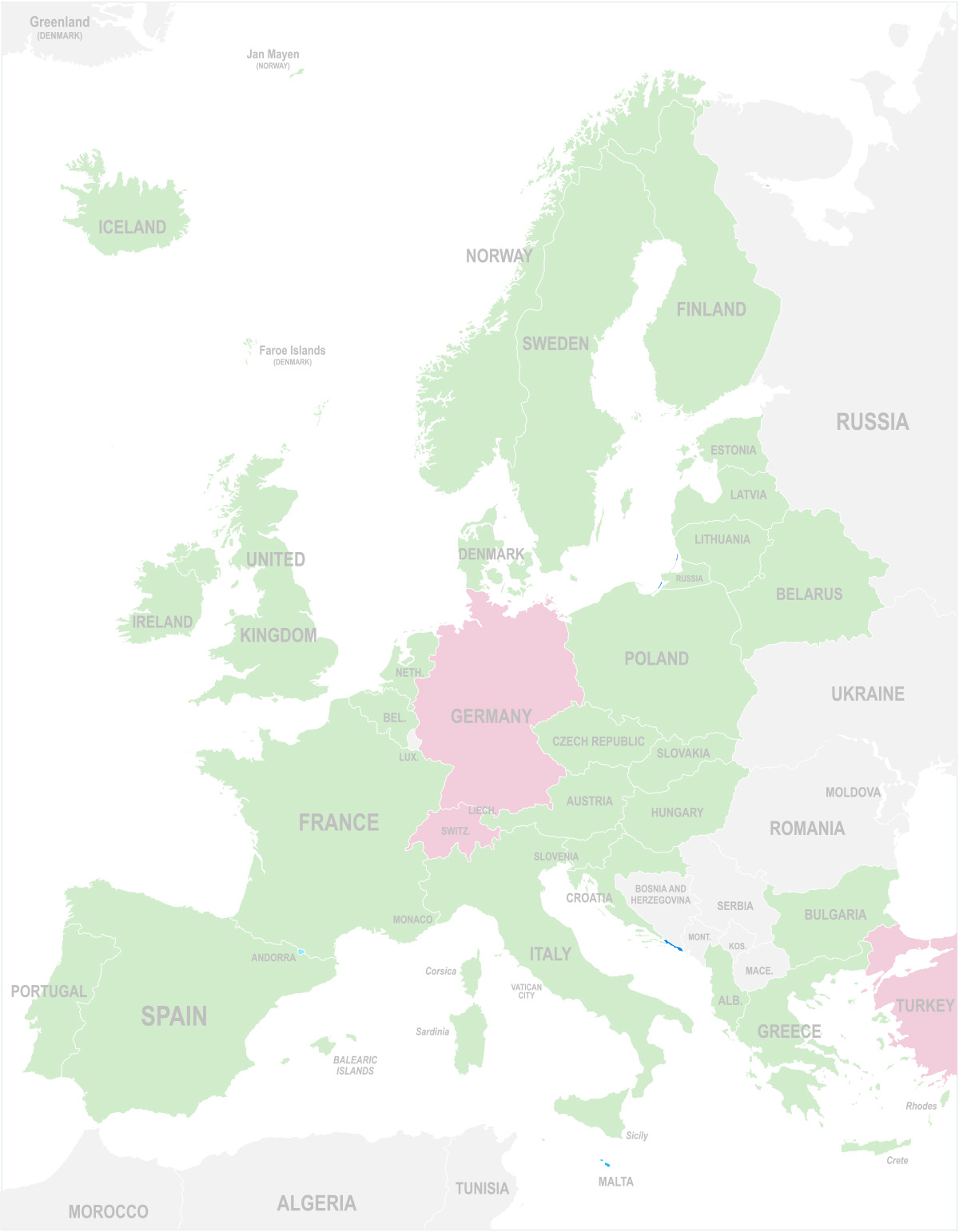
Against this background, we can offer treatments with donated eggs at our IVF centres in  Austria
(Bregenz or Salzburg).
In
 Germany and
 Switzerland, egg donation is currently not permitted (as of July 2020).
In which countries is egg donation permitted?
A clear yes or no, permitted or not permitted, is often not enough to describe the legal situation regarding egg donation, because there are usually different conditions laid down in national laws and guidelines (country-specific provisions) as well as in EU regulations.
Egg donation in German-speaking countries:
|
in Austria | egg donation permitted |
|
in Germany | egg donation not permitted |
|
in Switzerland | egg donation not permitted |
| Sperm donation | Egg donation | Egg & sperm donation | |
|---|---|---|---|
| Austria |  |
|
|
| Belgium | |
|
|
| Croatia | |
|
 |
| Czech Rep. | |
|
|
| Germany | |
|
|
| Italy | |
|
|
| Slovenia | |
|
|
| Spain | |
|
|
| Switzerland | |
|
|
| Netherlands | |
|
|
Notes:
- Austria: IVF/ICSI as long as a natural cycle is present, max. number of children per donor: 3
- Belgium: max. age of the woman for IVF/ICSI: 47 (embryo transfer), max. number of children per donor:
- Croatia: max. age of the woman for IVF/ICSI: no limit, max. number of children per donor: –
- Czech Rep.: max. age of the woman for IVF/ICSI: 49, max. number of children per donor: 5 (recommended)
- Germany: max. age of the woman for IVF/ICSI: –, max. number of children per donor: not permitted
- Italy: max. age of the woman for IVF/ICSI: 46, max. number of children per donor: 10
- Slovenia: max. age of the woman for IVF/ICSI: reproductive age, max. number of children per donor: children in 2 families
- Spain: max. age of the woman for IVF/ICSI: menopause (50 x 2), max. number of children per donor: 6
- Switzerland: max. age of the woman for IVF/ICSI: no, max. number of children per donor: not permitted
- Netherlands: max. age of the woman for IVF/ICSI: 49, max. number of children per donor: –
Source: "Survey on ART and IUI: legislation, regulation, funding and registries in European countries: The European IVF-monitoring Consortium (EIM) for the European Society of Human Reproduction and Embryology (ESHRE)", C Calhaz-Jorge, C h De Geyter, M S Kupka, C Wyns, E Mocanu, T Motrenko, G Scaravelli, J Smeenk, S Vidakovic, V Goossens, Human Reproduction Open, Volume 2020, Issue 1, 2020, hoz044, https://doi.org/10.1093/hropen/hoz044 Published: 06 February 2020, https://academic.oup.com/hropen/article/2020/1/hoz044/5715201
Anonymous or open egg donation?
One of the key regulations subject to country-specific provisions concerns the way in which egg donation can be used. A distinction is made between anonymous and non-anonymous (open) egg donation. Two examples:
Austria: open
Since 2015, a new Reproductive Medicine Act has been in force in Austria that permits non-anonymous egg donation. The law stipulates that a child conceived with donated eggs has the right, from a certain age, to obtain information about the donor. Consequently, the identity of the donor must be disclosed. In Austria, the fertility centre where the treatment was carried out is obliged to provide this information.
 Czech Republic: anonymous
In countries that permit anonymous egg donation by law (such as the Czech Republic), information about the donor is not passed on, even at the request of the recipient or the child (this is laid down by law). The donors' data must be treated as strictly confidential and is kept under lock and key by the fertility centre.
International network of experts
This shows how important comprehensive advice from a specialised physician is in order to clarify the options and background of the treatment in connection with country-specific advantages and disadvantages.

Dr. Adriane Damko
Today we see that infertile couples who undergo IVF treatment with egg donation increasingly want an open donation, i.e. a non-anonymous donation. This gives these parents the opportunity in the future to tell their child about its origins in such a way that the identity of the donor is also known.
To increase the chances of finding suitable donors for these couples, we work very closely with our colleagues as part of the Next Clinics group. As a result, we can usually provide the necessary number of donors.